
Modular autonomous underwater vehicles, built to scale
One architecture, three platforms. The Strydent AUV family scales from small, attritable units to deep-water assets – delivering Swarm as a Service from 100 meters to 4,000 meters.
One modular architecture,
Three
mission classes
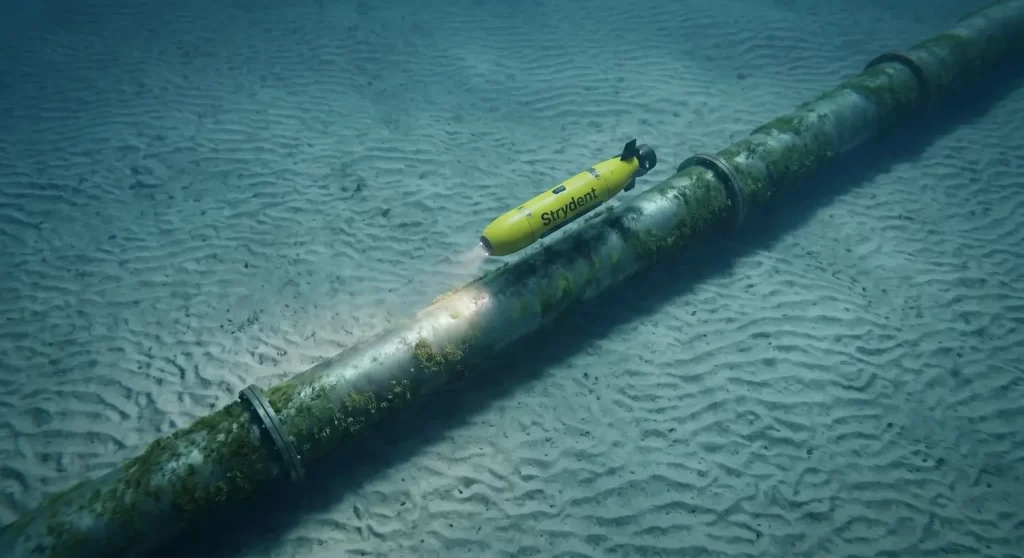
Strydent has developed intelligent autonomous underwater vehicles with next-generation capabilities – autonomous navigation, unit-to-unit and unit-to-command communications, location identification, and true-swarm, synchronized effects.
Every platform shares the same modular, scalable architecture: depth, endurance, and payload scale with the mission, while the Poseidon autonomy stack and swarm behavior stay common across the fleet.
Pilots required
Three platforms,
one
mission system
From the deployed, attritable Model 100 to the deep-water Model 4000 – pick the platform that fits the depth and the mission.
100
Small, low-cost, attritable AUVs build for ISR, direct effects, imaging, ship inspection, and swarm operations. Hand-launchable and man-portable, requiring no crane or additional personnel to deploy.
1000
Deep-rated, engineered for extended undersea operations. Supports full payload suite, including Synthetic Aperture Sonar (SAS), hydrographic sensing, and advanced deep-water survey capabilities.
4000
Deep-water platform delivered in partnership — integrating Strydent autonomy into existing assets for seabed operations to 4,000 meters.
Compare the fleet
Specification | Strydent 100 Deployed | Strydent 1000 In Production | Strydent 4000 Integration |
|---|---|---|---|
Length | 1 m | 1–2 m | 3–5 m |
Internal Diameter | 6 in | 10 in | 10 in |
Dry weight | 25 lb | 80 lb | 220 lb |
Max operational depth | 100 m | 1000 m | 4000 m |
Endurance & max range | 36 hrs / 100 km | 48 hrs / 160 km | 80 hrs / 200 km |
Speed | 5–7 KTS max | 5–7 KTS max | 5–7 KTS max |
Energy source | 9.6 kWh Li-ion | 2 × 14 kWh | 3 × 14 kWh |
Sonar suite | Modular | SAS / SSS / MBES | SAS / SSS / MBES |
Nominal speed 3–4 knots across all platforms. Endurance and range vary with
payload and sea state.
Small, attritable, and already in the water
- At Edge Charging - Li-ion battery with wet-mate charging port.
- Sealed Propulsion - brushless 3-blade shrouded thruster with magnetically coupled drive.
- At Edge Processing - No need for constant connection, vehicles think for themselves, need minimal to no human intervention, and store/transmit data for post-mission analysis.
Modular Payload Bay
Multiple Sensors, Missions, Roles
Every Strydent platform is fully configurable for the mission – sensors and payloads are swapped per task and managed through an onboard processor for analysis at edge.
Sensing & Imaging
- High-resolution cameras with high-lux lighting - EO/IR imaging (IR while surfaced)
- Sonar - Synthetic Aperture (SAS), Side-Scan (SSS), Multibeam (MBES)
- LiDAR - hi-res 3D models for structural analysis
- Sub-bottom profiler, laser, magnetometer, environmental sensors
- CTD probes - conductivity, temperature, depth & pressure
Navigation & Positioning
- InertialSense INS - accuracy to .1% of distance traveled
- Doppler Velocity Log (DVL) coupled with INS
- High-accuracy GPS for surfaced locational data
- USBL acoustic positioning - relative to surface vessels at depth
- Terrain & celestial navigation as positional fail-safes
Communications
- Spatial comms - Free-Space Optical (FSO), acoustic & RF fused
- LPD / LPI profiles - low probability of detection & interception
- Teledyne Benthos USBL acoustic system + marine 5G
- User Defined RF - Iridium SATCOM, Software-Defined Radio, LoRa / HaLow,
- UHF, cellular, fiber-optic cross-domain links
Inspection & Repair
- Methane & hydrocarbon detectors - locate oil & gas leaks
- Ultrasonic thickness gauges (NDT) - corrosion & erosion detection
- Cathodic protection monitoring on pipelines & structures
- Ultrasonic anti-fouling - HullSonic HS200 module
- Manipulator arms - probes, torches, clamps, welders, samplers
Many Vehicles,
One Objective
Strydent’s key value driver is the ability to operate independently in swarms of 10, 100, or 1,000 units — each carrying different payloads, all contributing to a single collective mission to improve efficiency and overall mission profiles.
- Mixed Payloads - vary sensors across the swarm to cover an entire mission set at once.
- Independent Units - each vehicle operates on its own while contributing to the collective objective.
- Powered by Poseidon™ - the autonomy stack coordinating the entire fleet. Explore Poseidon™
Find the right platform for your mission
Tell us about your depth, endurance, and payload requirements, and our team will help configure the right Strydent AUV – or integrate Strydent autonomy into your existing assets.